
|
Before I jump into the prototype, let's get one thing straight: The first Ghostbusters is the better movie. I don't dare debate that. But if you were to compare the scariness of the ghostly goons, Zuul and the Terror Dogs and Stay Puft all packed together in one corner of the ring, and Vigo menacing in the other, Ghostbusters II wins hands down. The Marshmallow Man would kill me with a smile on my face, but I wouldn't feel warm inside when Viggy tore me apart; I'd leave this world a lot less happier and a whole lot hungrier.
The ultimate pick-up line: "So you wanna play Boggle or Super Mario Bros.?" Vigo the Carpathian, Vigo the Cruel, Vigo the Torturer, Vigo the Despised, Vigo the Unholy, Vigo the Butch—whatever you want to call him, dude was intense. Having lived for over a century, ruling as a tyrant and murdering hundreds of his own people, he was finally overthrown only after being poisoned, stabbed, shot, hung, stretched, disemboweled, drawn, and quartered. A fighter to the end, that one.
The NES Advantage: Now You're Playing With Psycho-Reactive Plasma! Before Hammer, my mother used to calm me down after a bad dream by making the Sign of the Cross. With Hammer, I wouldn't even have to sign anymore; I could just command the nightmare to stop and pray that I wouldn't hear a disembodied voice holler back, "Hammer Time!" If a Rick James beat materialized at 3 A.M., The Devil's Hour, I'd instruct my parents to call the Catholic diocese first thing in the morning. Turns out, I had nothing to worry about after all because years later I found out that the real Vigo portrait isn't an actual painting at all but a giant photo print that was retouched and weathered to look old. That's a relief and all, but what the hell am I going to do with all these neon posters?
Although I have covered my fair share of movie props before on the site, I held back my Ghostbusters II collection for a special occasion. At long last I think it's time to break out the champagne and tubs of non-toxic Ecto-Plazm.
"We're back!" This 5 x 2-inch name patch was custom-made for Ray Stantz’s (Dan Aykroyd) iconic jumpsuit in Ghostbusters II. The uniforms worn by the Ghostbusters in the second movie were made by Flight Suits Ltd. of El Cajon, California. Here she comes, Miss America! A pre-production maquette is a reference model that prop makers and makeup artists use to test their movie magic effects. This 1/3 scale painted plaster bust helped in developing the makeup for Ray Stantz's terrifying transformation when Vigo momentarily possesses him. One of the film's creature shop crewmembers (Harold Weed) wore the actual demonic cosmetics in the film. An earlier scene hinting at Ray's possession did not make the final cut. The official movie comic book adaptation shows Ray under Vigo's command at the museum and later driving the Ecto-1A recklessly around the city and through Central Park, intentionally trying to crash and kill the gang. The Ghostbusters' equipment has always fascinated me, and I, like every other kid at the time, begged for those plastic role-playing toy replicas made by Kenner. Dan Aykroyd, who co-wrote the script, is a true believer in the supernatural and even belongs to the oldest paranormal society in North America. He based much of the film's pseudo-science on real ghost hunting theories and ghost hunter equipment. The giga-meter, like the PKE meter, is loosely fashioned after EMF meters, devices that measure the naturally and unnaturally occurring electromagnetic fields in the environment. The common ghost theory is, when spirits materialize, EMF readings will spike. Whether that's true or not depends on your belief in ectoplasmic entities. That said, high EMF has been scientifically shown to cause visual and auditory hallucinations, which may just explain the shadow people who like to claw at some folks' closet doors in the middle of the night. In Ghostbusters II, the giga-meter tracks New York City's growing psychomagnatheric energy and leads the busters to the underground River of Slime.
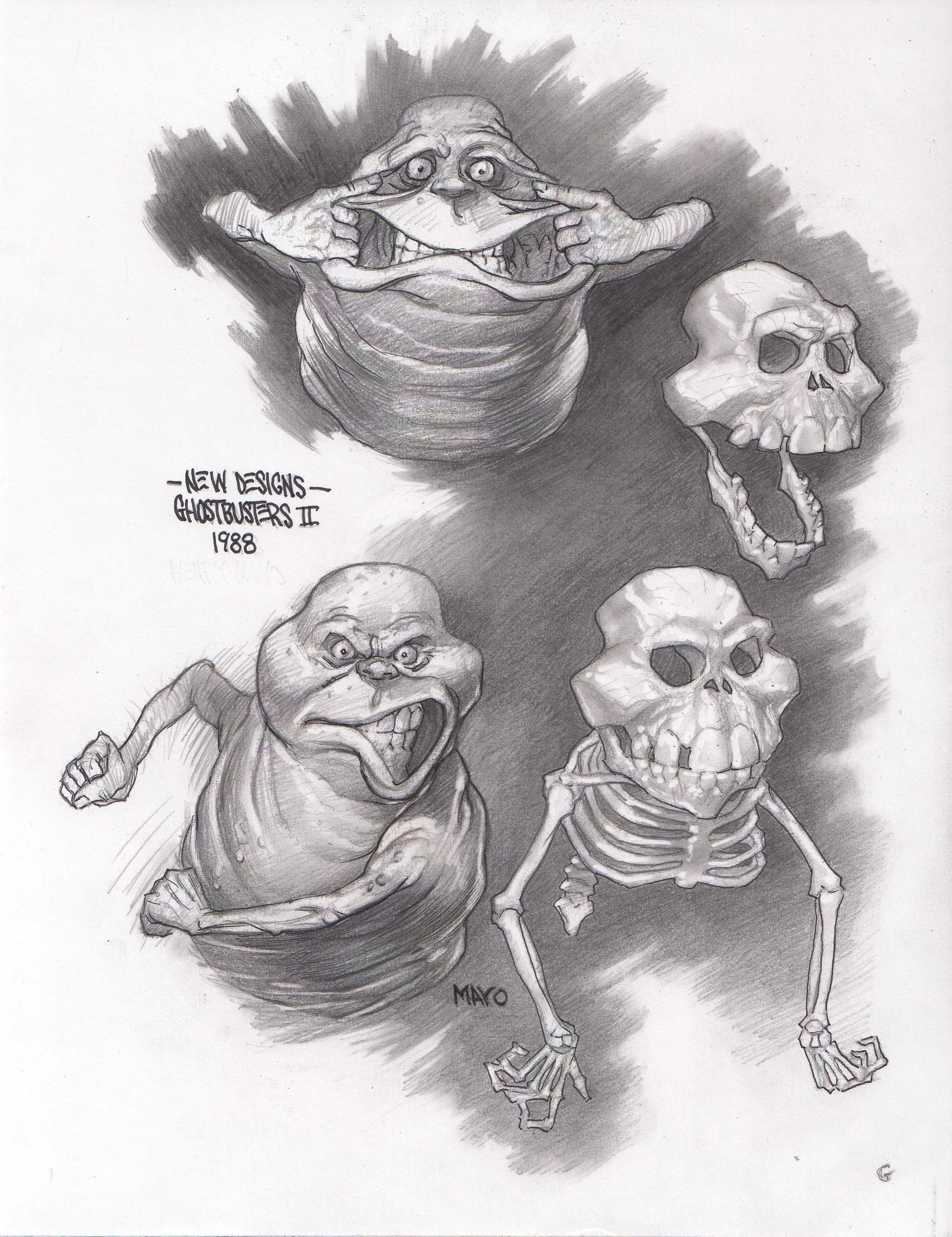
Concept artist Henry Mayo drew this original Slimer concept artwork for Ghostbusters II. The piece is done in graphite and orange pencil, mounted on board, and measures 8.5 x 11 inches. This particular “Redesign” Slimer drawing was the final design before the puppet/suit was created. Ivan Reitman asked to see more emotion from the lovable green ghost, and so Mayo sketched Slimer in these four fun and expressive poses. Tim Lawrence, the Industrial Light & Magic Ghostbusters II Creature Shop supervisor, brought Mayo on board as a visual designer. The two sat on the floor of Lawrence's apartment and developed the look of the Scoleri Brothers, which became the first character designs that were approved and shot. Mayo also contributed sketches and ideas for several other ghouls, such as the Theater Ghost, the Haunted Mink Fur Coat, and Vigo the Carpathian. After the movie was completed, Gross asked Mayo to do the Ghostbusters II Topps trading cards and other merchandising artwork. His other film credits include It, Jumanji, Men in Black, and Shrek.
This is another original, hand-drawn Slimer concept piece, dated 1988, by Henry Mayo for Ghostbusters II. This particular “New Designs” Slimer drawing received the approval of both director Ivan Reitman and executive producer Michael C. Gross. As for why Slimer, a Class 5 Full-Roaming Vapor composed entirely of ectoplasm, has a skeleton, Mayo explained to me, “I drew the skeleton so that we could establish how the puppet might move. Most of the time a simple wire frame would work but I thought it would be fun to make the design into something more.”
Mr. Hunchback here isn't so much a piece of movie memorabilia as he's a real neat piece of action figure history. Quasimodo belonged to Kenner's Real Ghostbusters Monsters Series, a line of figures based on classic horror icons like Dracula, Wolfman, Frankenstein Monster, Mummy, and the Zombie. What makes this figure special is the fact that it is a resin hard copy prototype, which means it was constructed by hand and then hand painted. A cool feat of craftsmanship, for sure, but the poor guy has seen better days; I had to wrap his stomach with a rubber band to prevent his body from separating and his guts and internal mechanisms from spilling out. I still love you, my little deformed freak.
Activision, the devils behind the first Ghostbusters video game, published a Nintendo Entertainment System follow-up based on the movie sequel in 1990. That same year, HAL Laboratory (the creators of Kirby) released its own Ghostbusters II game for the Nintendo Entertainment System under sublicense from Activision, adding "New" before the title to distinguish its version from Activision's, much like how the cartoon went by the name The Real Ghostbusters to differentiate the series from Filmation's Ghostbusters. While Europeans could choose between HAL's New Ghostbusters II and Activision's Ghostbusters II, the rest of the world didn't have a choice in the matter—Japan only received HAL's version, and America, only Activision's. American gamers got slimed in the deal. HAL's New Ghostbusters II not only shamed Activision's efforts back in the day, but the game has gone on to be considered one of the best PAL/Family Computer exclusives for Nintendo's 8-bit system. Players get to choose two Ghostbusters (or Louis Tully). The first character acts as the aggressor who stuns spirits with a proton stream blast (by pressing down the A button), while the second character takes on the role of the ghost trapper (by pressing the B button). Your ghost hunting tag team goes room-to-room zapping and sucking up all of the slimy spirits until an arrow appears instructing the player to move on to the next hotbed of paranormal activity. The ghost busting continues for five levels, beginning in the courtroom, then underground in an abandoned subway line, inside of Dana's apartment building, back underground into the River of Slime, and finally through the Manhattan Museum of Art where Vigo and Janosz plan their reign of destruction. All things considered, New Ghostbusters II sticks to the script and remains fairly faithful to the movie. Take, for instance, the game's bosses.
Hey, that's Satoru Iwata, current president of Nintendo! Iwata started out in the game industry as a programmer at HAL. Relying on scaringly simple but rewarding game mechanics, the 30-odd minutes it takes to beat New Ghostbusters II will surely satisfy any Ghostbusters fan. Unfortunately, gamers in the States looking to get their ghostly fill were forced to import their New Ghostbusters II copies from overseas. Many learned a valuable lesson in the process: Not all television standards are created equal. North America and Japan use 60 hertz TVs running at 30 FPS/525 lines, while Europe uses 50 hertz TVs running at 25 FPS/625 lines. The difference between these two standards sometimes resulted in inferior NTSC-to-PAL video game ports with distracting letterbox black borders, slow down, or other abnormalities. In the case of New Ghostbusters II, inserting a PAL cart into an American Nintendo Entertainment System speeds up the music considerably.
The following prototype proves that HAL had plans to bring New Ghostbusters II Stateside. How does the unreleased USA prototype fare? Strap on your proton packs and don't cross the streams. We're going in!
The cartridge has a plain white label with the words: NEW GHOSTBUSTERS II NES USA VERSION.
For an unreleased prototype, there sure are a lot of copies of this game. By my count, four in total are known to haunt the world. "2" is written in black marker on the bottom right-hand corner of my copy, but who knows how many more are really out there? This prototype came from a collector in the Netherlands.
More Pictures: Back of PCB / Back of Cartridge / Inside Cartridge / Mitsubishi Sticker Inside, there are Mitsubishi EPROM chips on an official Nintendo NES-SKEPROM-01 development board. Enough with the ogling. Let's get bustin', buster.
I'm Sorry, Dave. I'm Afraid I Can't Do
That.
Copyright Busted
Title Screen
There's Something Strange In The Aspect
Ratio The USA prototype has a wider picture than the PAL/Family Computer versions. The real loser is the Family Computer version for having fewer lines vertically and horizontally.
Notice how you can see more of the curtain and the audience in the USA prototype.
The left border blocks a portion of the skyline lights.
As Easy As Eating A Twinkie
And You Too!  And that'll do it. As you can see, this game was ready and raring to be released in the United States. We could have made some wonderful memories together, New Ghostbusters II. Bobby Brown, come cheer a brother up with some of that post-New Edition, new jack swing. |



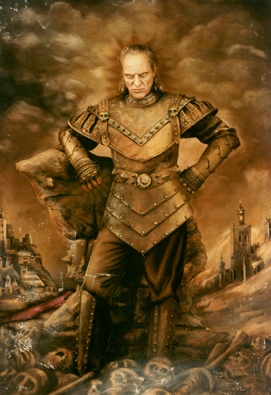 I
blame his hellish portrait for many sleepless nights in my youth. So dark,
foreboding, evil... Vigo's painting forced me to respect and nervously
admire old master art. That is to say, I believed that canvases could
be homes to ghosts like in the movie (the older the artwork, the angrier
the specter). To make sure that I didn't accidentally bring any spiritual
stowaways into the house, nothing but freshly printed MC Hammer posters
ever adorned my bedroom walls. In the worst-case scenario, I knew that
I could handle parachute pants whooshing back and forth across the air
above my bed at night. I knew that Hammerman couldn't touch this—the
"this" being me, of course.
I
blame his hellish portrait for many sleepless nights in my youth. So dark,
foreboding, evil... Vigo's painting forced me to respect and nervously
admire old master art. That is to say, I believed that canvases could
be homes to ghosts like in the movie (the older the artwork, the angrier
the specter). To make sure that I didn't accidentally bring any spiritual
stowaways into the house, nothing but freshly printed MC Hammer posters
ever adorned my bedroom walls. In the worst-case scenario, I knew that
I could handle parachute pants whooshing back and forth across the air
above my bed at night. I knew that Hammerman couldn't touch this—the
"this" being me, of course.




 Scoleri
Brothers
Scoleri
Brothers


 Slimer

 Nanny
Janosz
Nanny
Janosz

 Psychomagnotheric
Slime ("Mood Slime")
Psychomagnotheric
Slime ("Mood Slime")

 Dr.
Janosz Poha
Dr.
Janosz Poha

 Prince
Vigo von Homburg Deutschendorf
Prince
Vigo von Homburg Deutschendorf


